Every small business owner I talk to about a new website is quietly asking the same question before they ever pick up the phone: "Am I about to get ripped off?"
It's a fair worry. Web design pricing is famously opaque — quotes ranging from $500 to $50,000 for what sounds like the same thing on the surface. Some of that spread is real (an agency building a 200-page site with custom integrations should cost more than a freelancer building a 5-page brochure). But a lot of it is fog the industry profits from.
This post is the antidote. I'm going to give you a numbers-first breakdown of what a small business website should cost in 2026, what drives those numbers up or down, and how to tell whether a quote is fair. I build sites for small businesses for a living — typically starting at $1,000 with a 2–6 week turnaround — so I'm not pretending to be neutral. But I am going to be honest.
I'm based in Baltimore and work with small businesses across the DC–Maryland–Virginia corridor, but most of my clients now find me remotely from anywhere in the US. Geography matters less than it used to; what matters is whether the person quoting you can actually explain what you're paying for.
The Four Tiers of Small Business Websites
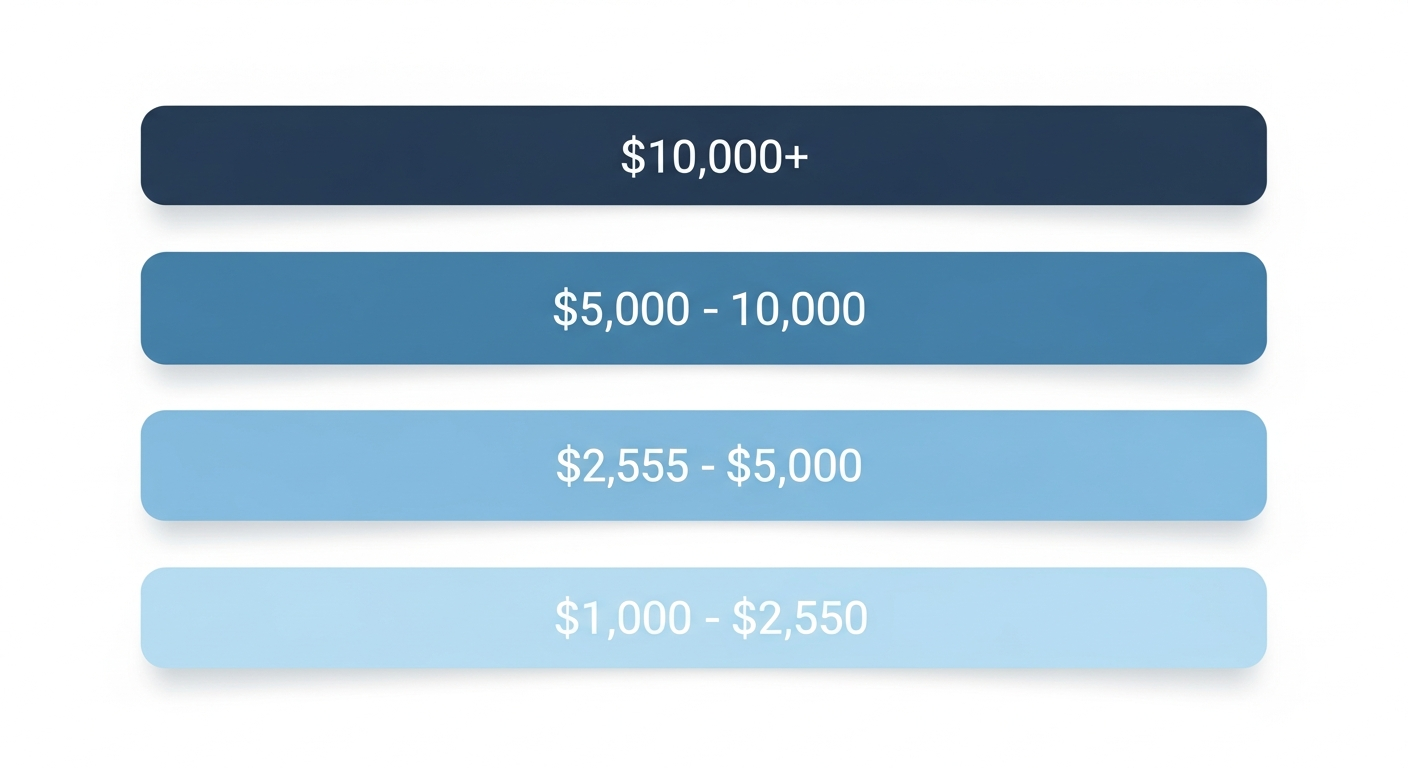
Before you read another quote, decide which tier you actually belong in. There are roughly four, and they're separated less by quality than by who's doing the work and how much of it is custom.
DIY platforms (Wix, Squarespace, GoDaddy): $200–$600/year. Fine for a hobby, a side project, or a placeholder while you figure things out. You'll hit walls on SEO, performance, and design control quickly, and the lock-in is real — exporting your site to another platform later usually means rebuilding from scratch. If you're weighing an all-in-one bundle instead, OnePagey's guide on how much a small business website costs in 2026 is a useful further-reading resource.
Budget freelancer or offshore shop: $500–$2,000. Cheap, but you're often buying a recycled template, minimal SEO setup, and no ongoing support after launch. Watch for surprise hosting fees that show up in month two and revision policies that turn every small change into a billable event.
Experienced freelancer or small studio (this is where I sit): $1,000–$8,000. Custom design, a proper SEO foundation, and direct conversations with the person actually building your site. Timelines run 2–6 weeks for most projects. You should expect a clear scope, a written proposal, and ownership of your domain and hosting account at the end.
Agency: $10,000–$75,000+. Justified if you need multi-stakeholder strategy, large content operations, custom web applications, or ongoing marketing services bundled in. Overkill for a 5–20 person business that just needs a site that generates leads.
The simple rule: match the tier to your actual goal, not to your ego. Most small businesses I meet who paid agency prices got a site that a good freelancer would have built for a third of the cost.
What Actually Drives the Price
If you understand the variables, you can predict your own quote within a few hundred dollars before you even contact a developer. Here's what moves the number.
Page count and complexity is the biggest lever. A 5-page brochure site is roughly a fifth of the work of a 40-page site with a services directory, a team page with bios, and a filterable blog. Anything that needs unique layouts (rather than reusable templates) adds time.
Design approach is the next variable. A customized template — one of the cleaner ones from a respected source, modified to fit your brand — is dramatically cheaper than a fully custom design built from scratch. Both can look great. Custom is usually only worth it if your brand is the product.
Content is the line item nobody talks about. If you have your copy written and your photos shot, you save real money. If you need a developer to write your About page, source stock images, or coordinate a photographer, those costs land on your invoice — fairly, but they land.
Functionality is where small projects become medium projects. Online booking, e-commerce, gated memberships, CRM integrations, lead-routing logic — each of these is its own small build inside the bigger build. My website service page walks through what's typically included versus what bills as an add-on.
Platform choice matters too. WordPress is flexible, SEO-friendly, and has the deepest plugin ecosystem on the planet — but it needs maintenance. Webflow is cleaner to maintain and has fantastic built-in hosting, but it has its own learning curve and content limits. Shopify is purpose-built for product sellers. The right answer depends on what you're actually trying to do — I dig deeper into the tradeoffs in my WordPress vs Webflow comparison.
Finally, SEO setup. A quote that says "SEO included" can mean anything from "we installed a plugin" to "we built your information architecture around the keywords your customers actually search." Ask which one you're getting. My approach to SEO is to bake the foundation in during the build, not bolt it on afterward.
Real Example Budgets
Abstract ranges are useful but vague. Here are three concrete scenarios I see all the time so you can find yourself on the map.
Local service business (plumber, dentist, therapist, contractor). A 5–8 page site with a contact form, a booking link, location and service-area pages, and local SEO. Realistic build cost: $1,000–$3,000. Add hosting and maintenance at $30–$75/month afterward. Timeline: 2–4 weeks.
Professional services firm (law, consulting, accounting, agency). An 8–15 page site with team bios, case studies or client work, lead-generation forms, a blog or insights section, and integration with your email marketing tool. Realistic build cost: $2,500–$6,000. Timeline: 4–6 weeks.
Product or e-commerce startup. 10+ pages with full Shopify or WooCommerce setup, product photography, payment processing, shipping configuration, and an email capture flow. Realistic build cost: $4,000–$12,000. Timeline: 4–8 weeks. Product photography and copy can easily add another $1,000–$3,000 if you don't have it ready.
None of these include the recurring costs everyone forgets: a domain name (~$15/year), hosting if you self-host (free to $40/month depending on platform), and any premium plugin licenses your build relies on. Those should be itemized in your proposal — not buried in a single line item.
The Hidden Fees to Watch For
This is the part of the conversation most developers won't have with you, so I will. These are the traps I've seen small business owners walk into more times than I can count.
Domain and hosting markups. You should own your domain directly at a registrar like Cloudflare or Namecheap. If your developer registers it on their account "for convenience," you don't really own your business name online.
Premium plugin licenses billed annually. Some plugins are absolutely worth it. But if your developer is bundling six "premium" plugins you'll never use, you're paying license fees forever for features you don't need.
Stock photo fees. Should always be itemized. Free libraries like Unsplash and Pexels are excellent for most small business needs.
Revision limits that trigger change orders. Reasonable revision policies exist (I include one to two rounds depending on the package). What's not reasonable is a contract where every text tweak after launch becomes a billable change order.
Monthly retainers that lock you in. Maintenance plans are great. Maintenance plans you can't cancel without losing access to your own website are not.
Proprietary platforms. If your site can only be edited inside one company's tooling and can't be exported, you're a tenant on your own website. Stick with platforms where you can hire any developer to take over.
SEO "packages" that are really just automated reports. A monthly PDF from a tool isn't an SEO strategy. Real SEO work is content, internal linking, technical fixes, and performance — things you can see in your search rankings, not in a dashboard screenshot.
The summary version: a fair quote shows you the line items. If you can't see what you're paying for, you're paying too much.
What to Ask Before You Sign a Contract
These are the questions I wish every small business owner asked me before our first call. They protect you, and honestly, they make the project go better for the developer too — clarity at the start saves arguments at the end.
Who owns the site, the domain, and the hosting account when we're done? What is the total cost including the first year of hosting and any required licenses? How many revisions are included, and what happens after that? Who's writing the content — me, you, or a copywriter? Will the site be built on a platform I can hire anyone to maintain? What's the timeline, and what happens if we slip? Is SEO foundation included, or is it a separate engagement? What's the cancellation policy if I need to stop the project mid-build?
If a developer can't answer those eight questions in plain English in a first call, that's the answer.
The Bottom Line
A small business website in 2026 should cost somewhere between $1,000 and $8,000 for most businesses, launch in 2–6 weeks, and come with a clear line-item breakdown. Anything wildly outside that range deserves scrutiny — not because it's automatically wrong, but because you deserve to understand why.
If you want a sanity check on a quote you've already received — or you're just starting and want to know what fair pricing looks like — grab a free 30-minute consultation. Even if you don't end up hiring me, you'll walk away knowing what a fair quote should look like and what questions to ask. Transparent pricing, direct communication, 2–6 week turnaround, sites starting at $1,000. That's the deal.
More on small business websites: Do I Need a Website for My Small Business in 2026? · 5 Must-Have Website Features for Small Businesses · How to Choose a Web Developer in Baltimore (2026)
Your digital website sherpa: practical web tips for small businesses, straight to your inbox
Join the Digital Website Sherpa newsletter. No spam, just practical, actionable advice to help you grow your business online. Unsubscribe anytime.
Paul Mulligan
Freelance Web Developer
Paul Mulligan is a freelance web developer based in Baltimore, MD with 10+ years of experience building WordPress and Webflow sites for small businesses. He focuses on clean design, fast performance, and real results.
Support My Open Source Work
I build free, open-source developer tools like Flavian and Aurelius. If you find my work helpful, consider supporting me on Patreon.
Support on PatreonRelated Articles
2026 Website Budget: Why AI Belongs in It
Read ArticleDo I Need a Website for My Small Business in 2026?
Read ArticleHow to Choose a Web Developer in Baltimore (2026)
Read ArticleReady to Transform Your Business's Website?
Let's discuss how I can create a website that attracts and converts more customers.
Get a Free Consultation